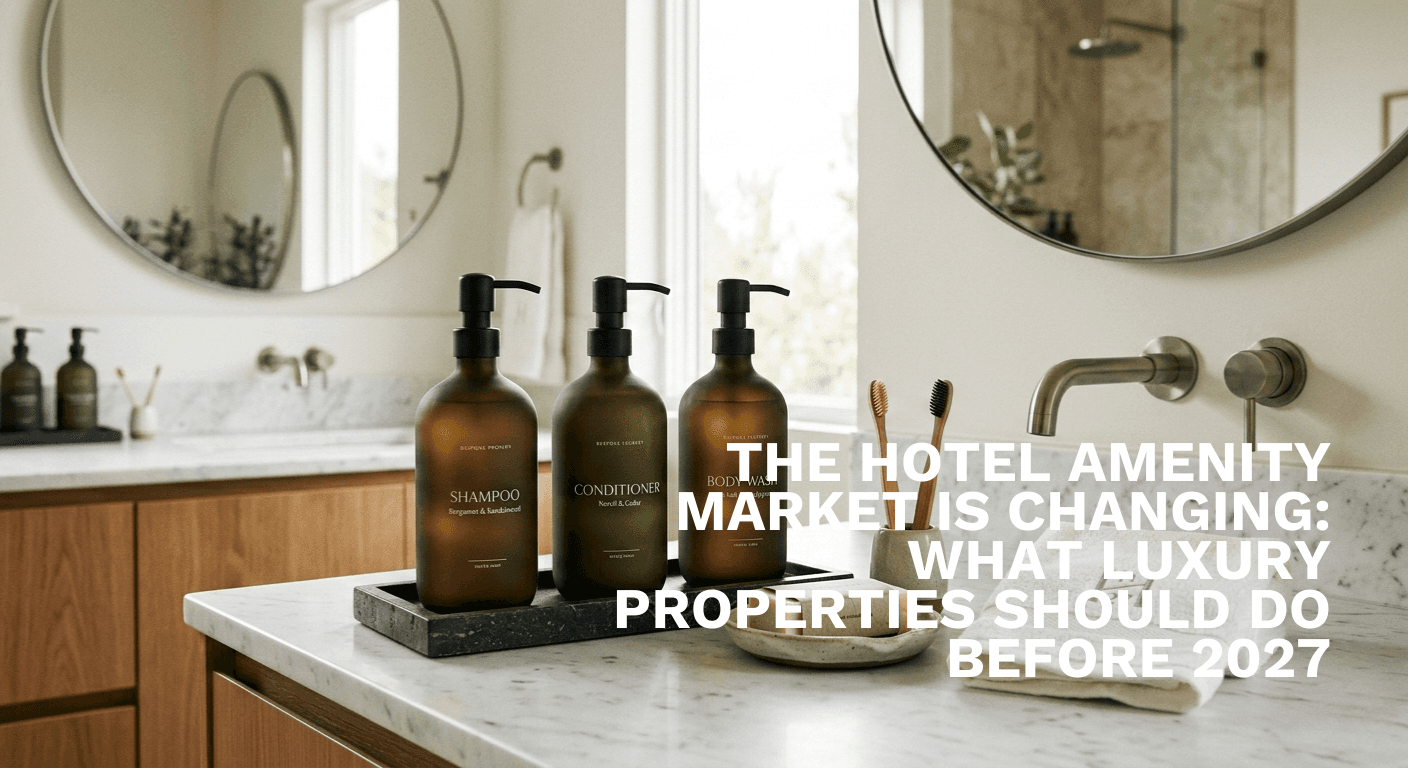
The Hotel Amenity Market Is Changing: What Luxury Properties Should Do Before 2027
Executive Summary Two forces are converging in luxury hospitality: regulatory pressure eliminating single-use plastic amenity formats, and a growing recognition that the standard licensed brand model has been undermining property identity rather than supporting it. Properties that treat this moment as a brand decision rather than a compliance exercise will build a meaningful competitive advantage heading into 2027. Those that switch to the cheapest compliant format will have solved a regulatory problem and created a brand one. This article covers the operational reality the industry is acknowledging, the value for money alignment problem, two models already producing results, and what Balearic properties specifically should do before the September procurement window.
The hotel amenity category is undergoing its most significant shift in decades. Two forces are converging simultaneously: regulatory pressure forcing a transition away from single-use plastic formats, and a growing realisation among luxury property operators that the standard approach to amenity selection has been undermining their brand rather than supporting it.
Properties that respond to both forces strategically, rather than treating them as separate compliance and procurement problems, will have a meaningful advantage in guest experience and brand perception heading into 2027. Those that simply switch to the cheapest compliant format will have solved a regulatory problem and created a brand one.
If you are ready to discuss what this transition looks like for your property, contact SOSOO Amenities directly.
The Operational Reality the Industry Is Acknowledging
The transition away from single-use miniatures has not been without complications, and the hospitality industry has been candid about this. Understanding the real problems is the starting point for solving them properly.
Single-use miniatures carry an emotional value that refillable systems do not automatically replace. For many guests, the small bottled amenity is part of the hotel experience, a tactile souvenir that travels home and extends the memory of the stay. Guest complaints about shared dispensers are not uncommon. The feeling of using a container that others have already used creates discomfort that signage alone does not resolve.
Theft presents a practical operational problem. Hotel operators report guests decanting product from dispensers into their own empty containers, a behaviour that was rare with sealed miniatures. The industry response has been pragmatic but imperfect: locking mechanisms, caps sealed with adhesive, or purpose-built non-opening vessels. Each solution introduces new complications. A permanently sealed vessel cannot be inspected for contamination. Consumption is harder to track. Residue in spent vessels creates waste that undermines the sustainability argument the format was intended to support.
The loss rate from poorly designed refillable systems can be substantial. And the genuine sustainability credentials of bulk dispenser formats remain debatable when the full lifecycle, including product waste, vessel end-of-life, and cleaning chemical consumption, is properly accounted for.
The honest conclusion is this: switching from single-use plastic to a bulk dispenser does not automatically produce a better outcome, environmentally, operationally, or experientially. The format change is necessary. The format alone is not sufficient. What determines whether the transition succeeds is the quality of the vessel, the formulation inside it, and the operational design behind it.
The Value for Money Alignment Problem
Beyond the practical complications, a more fundamental issue is reshaping how leading properties approach their amenity strategy.
The principle is straightforward: guests paying premium room rates expect the amenity experience to reflect that investment. A suite at €1,000 per night furnished with the same toiletries as a standard room communicates a disconnect between price and experience that attentive guests notice and remember. Market segmentation in luxury hospitality has become increasingly sophisticated, with guests making deliberate, informed choices between room tiers. The amenity programme is one of the signals that either validates or undermines that choice.
International luxury properties have already moved on this. The differentiator at the high end is no longer which recognisable retail brand is in the bathroom. It is how specific, considered, and exclusive the amenity feels. A product that exists only in that hotel, developed around that property's identity and guest profile, signals a level of investment and attention that a licensed retail brand, however prestigious, cannot replicate.
The irony of the current standard model is precise: a guest who uses Aesop at home finds it in a five-star hotel bathroom and feels nothing. The property has paid a significant premium for a product the guest already owns. The luxury signal collapses at the exact moment it should be reinforcing the room rate.
Two Models Already Producing Results
Forward-thinking properties are already demonstrating what the alternative looks like, and the results are instructive.
The co-branded signature model: Some hotels have moved beyond selecting an existing brand entirely, choosing instead to co-develop a signature amenity line with a cosmetic partner. The result is a collection carrying the hotel's own identity, formulated around a specific sensory brief, and performing well enough with guests that it has been made available for retail purchase. When an amenity sells out of a hotel shop, it has stopped being a cost and become a revenue stream. That shift in category, from operational expense to brand asset, is the most significant commercial argument for investing in a bespoke programme.
The total design approach: Others have taken a comprehensive approach to the amenity environment, where every material decision is considered as part of a coherent sustainability commitment. Ceramic dispensers replace plastic. Cotton pads and cotton buds sit in stone or marble vessels without plastic packaging. Additional amenity items are provided on request only, reducing consumption without reducing perceived luxury. Sustainability certifications validate the commitment publicly, making it visible to environmentally conscious booking platforms and guests.
Both models share a common principle. The amenity programme is treated as a design and brand decision, not a procurement one. The properties that have made this shift are not doing it reluctantly in response to regulation. They are doing it because their guests notice, respond, and return.
See how SOSOO develops both types of programme on the Services page.
Where the Market Is Heading
The most forward-thinking properties are going further still. Select resort hotels, particularly in Asia, have introduced amenity bars at check-in, where guests choose their own products from a curated selection, each described by benefit and ingredient. The amenity becomes part of the arrival experience rather than something discovered passively in the bathroom. This level of guest involvement is only possible when the products themselves are interesting enough to choose between.
This reflects a broader shift in how luxury hospitality thinks about personalisation. The guest who can choose between a skin barrier-focused body lotion and a brightening citrus formula at check-in has already had a brand experience before reaching the room. For properties serving a growing proportion of Asian guests, who bring significantly higher expectations around cosmetic quality, ingredient transparency, and hygiene standards, this level of engagement with the amenity programme is rapidly becoming an expectation rather than a differentiator.
The implication for procurement decisions made in 2026 is direct. Amenity programmes commissioned now will be in use through 2027 and beyond. The properties that invest in something genuinely specific to their identity this year will be operating with a competitive advantage as this market shift accelerates. Those that make a compliance-led decision will find themselves revisiting it within two seasons.
The Amenity as Retail Opportunity
One dimension of the bespoke amenity model that is frequently overlooked in the procurement conversation is its retail potential.
A guest who loves the body lotion in their room can purchase a licensed retail brand anywhere. The hotel captures no lasting commercial benefit from that preference. A guest who loves a product that exists only at that hotel has one option: buy it from the hotel. Several properties that have developed bespoke collections now sell them through their in-house retail or online channels, generating margin on a product that was originally procured as an operational cost.
For boutique and independent properties operating on tighter margins, a bespoke amenity line that generates retail revenue changes the financial logic of the investment entirely. The amenity programme pays for itself through a channel that a licensed brand model makes impossible.
What Luxury Properties in the Balearics Should Do Now
The September to November window is when Balearic properties set their supplier contracts and operational budgets for the following season. Decisions made in that window determine what guests experience from June 2027 onward.
The procurement timeline matters here. A fully custom amenity programme, from initial brief to first delivery, requires 14 to 20 weeks. A programme built on EU-compliant certified base formulations with property-specific branding can move faster. Either way, the conversation needs to start well before the September window, not during it.
The properties that will lead the amenity shift in Mallorca and Ibiza are the ones that approach this decision with the same design seriousness they bring to their interiors, food programmes, and service culture. The question is not which compliant format to switch to. It is what sensory identity the property wants guests to carry with them after checkout, and whether the current amenity programme contributes to that or contradicts it.
For most properties running a licensed retail programme, the honest answer to the second part of that question is: contradicts it.
SOSOO develops bespoke guest amenity collections for luxury hotels, boutique properties, spas, and superyachts in the Balearic Islands, built on Korean cosmetic formulation science and designed around each property's specific identity. Whether you are developing a co-branded signature collection, transitioning to a ceramic vessel programme with a documented sustainability framework, or beginning with a prestige suite pilot before a full property rollout, the formulation expertise, regulatory compliance, and programme design capability is here.
The shift is already happening in the properties that take guest experience seriously. The question is whether your property leads it or follows it.
Contact SOSOO Amenities to start the conversation.
Frequently Asked Questions
Why is the hotel amenity market changing now specifically? Two forces have converged simultaneously. Regulatory frameworks, including Balearic Law 8/2019, Spain's Law 7/2022, and the EU PPWR (Regulation EU 2025/40), are eliminating single-use plastic amenity formats. At the same time, the licensed retail brand model that has dominated luxury hotel amenities for two decades has lost its exclusivity signal as those brands expanded into global retail and became accessible to the guests most likely to stay in five-star hotels. Both forces point in the same direction: toward bespoke, property-specific programmes.
What is the value for money alignment problem in hotel amenities? Guests paying premium room rates expect the amenity experience to reflect that investment. A suite at €1,000 per night stocked with the same product as a standard room, or with a retail brand the guest already owns at home, communicates a disconnect between price and experience. The value for money alignment principle, increasingly discussed among hotel procurement professionals, holds that the amenity tier should match the room tier. Generic licensed brands cannot achieve this because they are not specific to any property.
What are the two models producing results in the bespoke amenity market? The first is the co-branded signature model, where a hotel co-develops an exclusive amenity line with a cosmetic partner. The collection carries the property's own identity and, in several cases, has been made available for retail purchase, converting an operational cost into a revenue stream. The second is the total design approach, where every material decision in the amenity environment, vessel format, packaging material, and product provision policy, is treated as part of a coherent sustainability commitment. Both models treat the amenity programme as a brand decision rather than a procurement one.
Can a hotel amenity programme generate retail revenue? Yes, but only through a bespoke programme the property owns. A guest who loves a product available only at that hotel has one place to buy it. Several properties with bespoke collections now sell them through in-house retail or online channels. This is not possible with a licensed retail brand, where the guest can simply purchase the product elsewhere. The retail opportunity is one of the strongest commercial arguments for investing in a bespoke programme rather than licensing an external brand.
When should a Balearic property start the amenity programme development process? For a fully custom programme, plan for 14 to 20 weeks from initial brief to first delivery, which means starting the conversation no later than early spring for a summer season launch. For the September procurement window, development should begin over summer to be ready for contract decisions. Properties using EU-compliant certified base formulations with custom branding can move on significantly shorter timelines. Contact SOSOO to discuss your specific season and timeline requirements.
SOSOO Amenities is based in Palma, Mallorca, developing bespoke guest amenity collections for luxury hotels, boutique properties, spas, and superyachts across the Balearic Islands. Formulation expertise developed between Seoul and the Mediterranean. Contact us at cs@sosooamenities.com or visit sosooamenities.com.