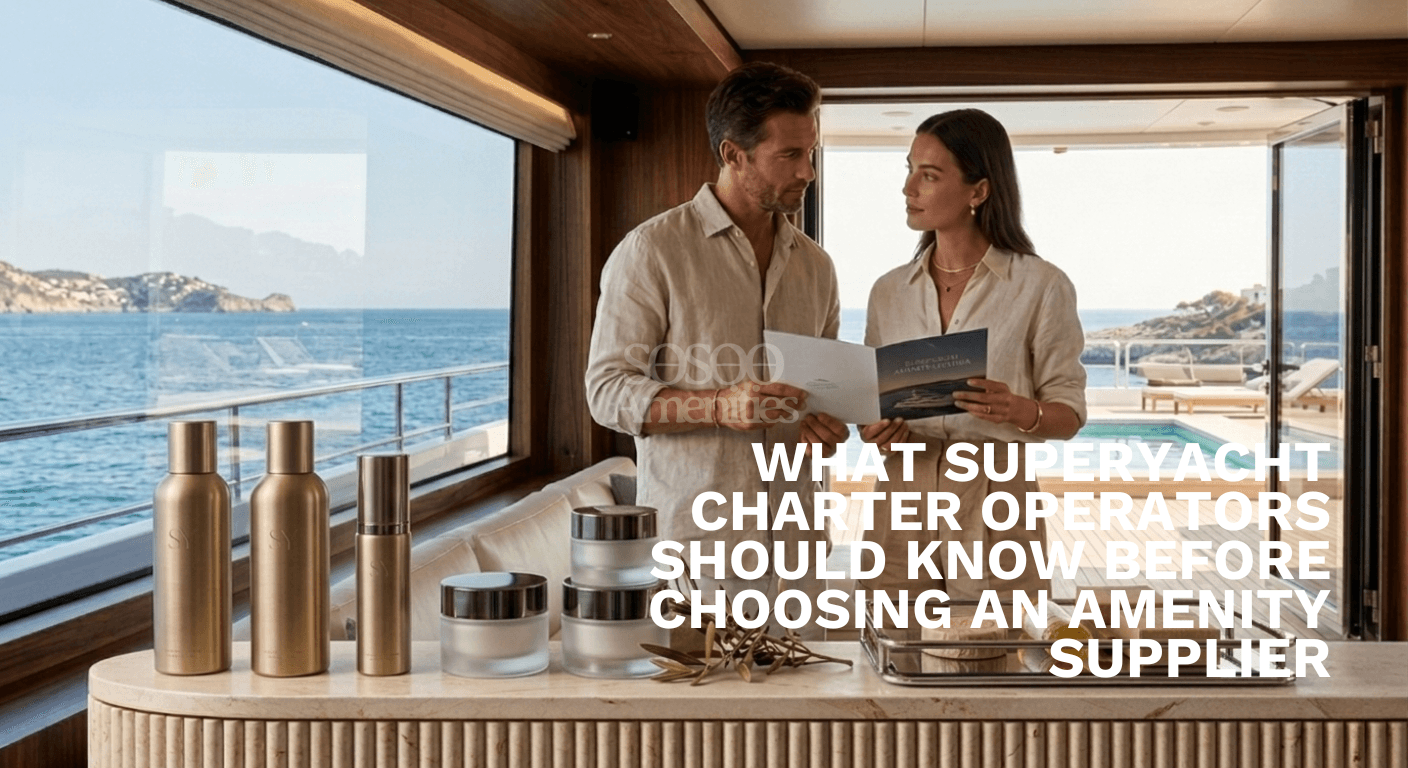
What Superyacht Charter Operators Should Know Before Choosing an Amenity Supplier
The amenity programme on a superyacht is not a minor procurement decision. For charter operators, it is a direct reflection of the vessel's positioning and the standard of experience guests expect. A poorly chosen supplier creates operational problems. A well-chosen one becomes an invisible but constant contributor to guest satisfaction and repeat bookings.
Most charter operators approach amenity sourcing the same way they approach provisioning: find a reliable supplier, confirm the product looks presentable, and move on. This is a missed opportunity. The operators who think more carefully about this decision end up with a product line that guests notice, comment on, and associate with the quality of the vessel itself.
This guide covers the key questions to ask before selecting a yacht amenity supplier, and the factors that separate a genuinely capable partner from a catalogue vendor.
Formulation Quality: What Is Actually Inside the Bottle
The most overlooked factor in yacht amenity procurement is formulation quality. Most generic suppliers provide products that meet basic safety requirements and smell acceptable. Very few provide formulations that perform at the level a superyacht guest expects.
Guests on high-value charters have exposure to premium skincare. They notice the difference between a body lotion that absorbs well and one that sits on the skin. They notice when a shampoo strips rather than nourishes. These are not trivial observations. They form part of the overall impression of the vessel.
Ask any prospective supplier where their formulations are developed and by whom. A credible supplier can answer this specifically. They should be able to explain the active ingredient approach, the texture philosophy, and how the formulation has been tested for performance, not only for safety compliance.
Suppliers drawing on Korean cosmetic formulation science bring a distinct advantage here. Korean beauty development culture prioritises skin barrier integrity, sensory texture, and high-performance actives at a level that European mass-market formulation does not routinely match. For a charter operator looking to elevate the guest experience, this distinction is material.
Customisation: Catalogue Selection Versus Purpose-Built Collections
There are two types of amenity supplier. The first offers a catalogue of existing products, sometimes with a label customisation option. The second develops products specifically for each client.
Catalogue selection is operationally straightforward but produces a generic result. If your amenity line is available to any operator who places a minimum order, it carries no exclusive identity for your vessel. Guests staying at a five-star hotel the following week may encounter the same product.
Purpose-built collections are developed around the vessel's identity, guest profile, and sensory direction. The fragrance profile, texture, packaging format, and ingredient selection all reflect a specific brief. The result is an amenity line that belongs exclusively to that vessel or fleet.
For charter operators competing in the high-value market, exclusivity in the guest experience is a legitimate differentiator. A bespoke superyacht amenity programme signals the same level of attention to detail as a custom interior or a curated provisioning list.
Format Suitability: Designing for Life at Sea
Not all cosmetic formats are appropriate for yacht environments. Charter operators need to consider practical factors that a standard hospitality supplier may not have encountered.
Refillable dispensers must be stable in marine conditions. Packaging must withstand humidity, salt air, and movement. Volume formats need to be appropriate for stateroom dimensions and storage constraints. Travel-sized formats for day charters or tender excursions require different specifications than full stateroom collections.
Reef-safe formulations are increasingly expected, particularly for vessels operating in protected marine areas across the Mediterranean, Caribbean, and Indo-Pacific. Biodegradable formulas and plastic-free packaging formats are relevant both for environmental responsibility and for compliance with local regulations in certain destinations.
Ask your supplier directly whether their formulations are reef-safe and whether they have experience developing formats specifically for yacht environments. A supplier whose primary market is land-based hospitality may not have considered these requirements in depth.
Compliance and Documentation
Every cosmetic product supplied to a European operator must comply with EU Cosmetic Regulation EC No 1223/2009. This includes safety assessments, product information files, labelling compliance, and responsible person documentation.
For vessels registered under non-EU flags operating in EU waters, compliance requirements can be complex. A capable supplier should be able to provide full documentation for every product in the collection and should understand the regulatory environment relevant to your vessel's operating area.
Do not assume that a supplier offering premium-looking products has the compliance infrastructure to support them. Ask for documentation at the proposal stage. Any serious supplier will provide it without hesitation.
Supply Reliability for Charter Seasons
Charter operations run to tight seasonal schedules. Amenity shortages during peak season are not recoverable. A vessel that departs without a complete amenity programme creates an immediate guest experience failure that no other detail can compensate for.
Evaluate any prospective supplier's supply chain specifically for your operating context. Key questions include: where is production located, what are standard lead times for reorders, how are urgent or supplementary orders handled, and whether there is local distribution capability near your home port or primary operating base.
Suppliers with production in Asia and no local distribution partner present a lead time risk for Mediterranean-based operators. A hybrid model, where formulation is developed internationally but production and distribution operate locally, removes this risk while preserving formulation quality.
For vessels based in or operating through the Balearic Islands, a supplier with distribution from Palma can offer 48-hour restocking capability across Mallorca, Ibiza, and the wider Mediterranean, which is a meaningful operational advantage during the June to September charter season.
The Right Question to Ask at the Start
Most operators begin the supplier conversation by asking about price and minimum order quantities. These are valid questions, but they are not the most important ones.
The most important question is: can this supplier develop a product that a guest on a high-value charter will genuinely notice and remember?
If the answer requires them to show you a catalogue, the answer is probably no.
A capable amenity partner starts the conversation by asking about your vessel, your guests, and the experience you want to create. The product follows from that conversation. This is the difference between a supplier and a formulation partner, and for charter operators who understand that every detail of the guest experience reflects on the vessel, it is a distinction worth taking seriously.
SOSOO Amenities develops bespoke guest amenity programmes for superyachts, charter fleets, and private vessels. Based in Palma, Mallorca, with formulation expertise developed between Seoul and the Balearic Islands. Contact us at cs@sosooamenities.com to discuss a custom programme for your vessel.