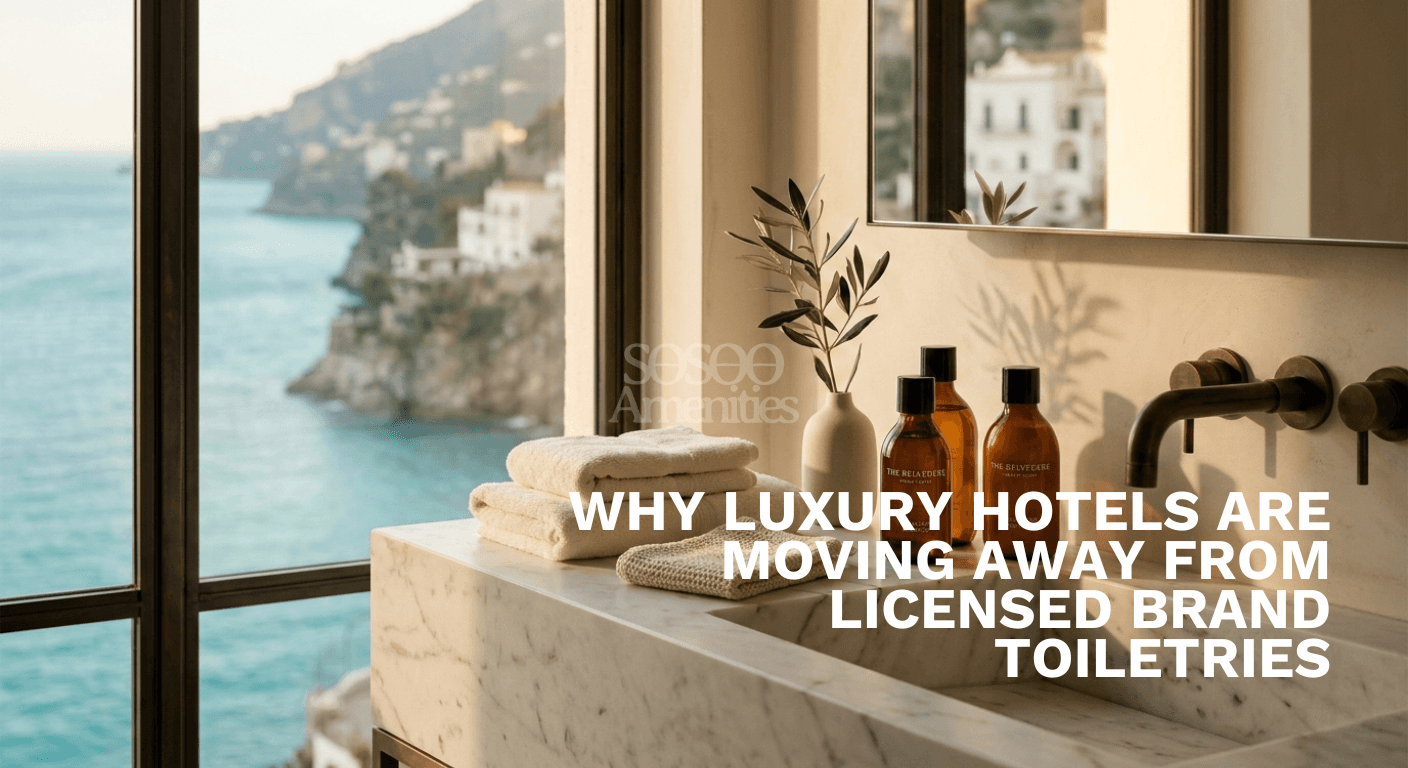
Why Luxury Hotels Are Moving Away from Licensed Brand Toiletries
If you use Aesop at home, finding it in your hotel bathroom is not a luxury experience. It is confirmation that the hotel made the same choice you did at the shops.
This is the quiet contradiction at the centre of how most luxury hotels currently approach their amenity programmes. They license recognisable retail brands, pay a significant premium to do so, and in return receive a product that a large proportion of their target guests already own, have already formed an opinion about, and can purchase themselves at any time. The exclusivity signal, which is the entire point of a luxury amenity, is gone before the guest opens the bottle.
It is a problem that has been building for years. And a growing number of hotel brand directors, GMs, and spa managers are now looking for a different answer.
How the Licensed Brand Model Became the Default
The logic behind licensing a brand like Aesop, Le Labo, Cowshed, or Malin+Goetz was sound when it began. These were niche, design-forward brands with strong sensory identities and limited retail distribution. Placing them in a hotel bathroom was a genuine signal: this property pays attention to detail, sources carefully, and understands quality.
That signal has eroded significantly. As these brands expanded into global retail, department stores, airports, and e-commerce, their exclusivity diminished. They became accessible to anyone willing to pay the retail price. For the demographic that stays in five-star hotels, that price is not a barrier.
The result is that a guest checking into a luxury property in Mallorca, then a design hotel in Copenhagen, then a boutique resort in the Maldives, can find the same product in all three bathrooms. The hotel has spent a premium on an amenity that communicates nothing specific about the property, the location, or the guest experience it is trying to create.
Borrowed Identity Is Not a Brand Strategy
There is a deeper issue beyond the familiarity problem. When a hotel licenses an external brand for its amenity programme, it is borrowing that brand's identity rather than building its own.
Every other element of a well-considered luxury property is developed with specificity. The interior design reflects a concept. The food programme reflects a chef's philosophy and local ingredients. The service approach reflects the property's culture. These are owned assets that belong to the hotel and contribute to its distinctiveness.
The amenity line sits in the most intimate space a guest occupies: the bathroom. It is the first thing encountered in the morning and the last thing used at night. For most properties, this space is designed with enormous care. The materials, the fixtures, the lighting, all of it intentional. And then a retail brand that anyone can buy is placed on the shelf.
A hotel that has invested in a strong design identity and a specific guest experience is undermining both when it defaults to a recognisable external brand for its amenities. It is the equivalent of a Michelin-starred restaurant serving supermarket bread.
What Guests Actually Want From a Luxury Amenity
Luxury hospitality guests are not looking for products they recognise. They are looking for products they cannot find anywhere else.
The most memorable amenity experiences are the ones that are tied specifically to a place. A scent profile developed around the botanicals of a particular island. A body lotion formulated with an ingredient grown within sight of the property. A texture or fragrance that guests associate exclusively with a single hotel and nowhere else.
This is what creates the kind of brand affinity that generates return visits and genuine word-of-mouth. Guests do not describe their stay by mentioning which retail brand was in the bathroom. They describe it by mentioning how the property made them feel. A bespoke amenity line contributes to that feeling in a way that a licensed product never can.
There is also a practical dimension. Guests who loved the amenity at a property with a licensed brand will simply buy that brand themselves. The hotel captures no lasting brand association from the experience. Guests who loved a product that exists only at that property associate that experience directly with the hotel. It becomes a reason to return.
The Seasonal and Signature Opportunity
One of the most underused possibilities in hotel amenity strategy is the seasonal or signature collection.
A property with a strong seasonal identity, a summer programme in Ibiza, a winter wellness retreat in the mountains, a harvest-season concept in a wine region, has a natural opportunity to develop an amenity collection that reflects that specific moment. Limited availability, local ingredients, a fragrance profile tied to the season. This is not a difficult concept to execute with the right formulation partner. And it creates a guest experience that is genuinely unrepeatable.
Signature collections work similarly for properties with a distinct design or cultural concept. A hotel built around Mediterranean architecture and local craft has a different sensory identity than a minimalist Nordic wellness retreat. Both deserve an amenity programme that reflects their specific character, not a product that also appears in hotels on three other continents.
These are not hypothetical possibilities. They are the kind of programme that guests photograph, mention in reviews, and specifically associate with the property. In an environment where luxury hospitality competes heavily on experience and reputation, this level of sensory specificity is a legitimate commercial advantage.
The Quality Argument Does Not Belong to Retail Brands
The most common objection to moving away from licensed retail brands is quality. The assumption is that a recognisable brand guarantees a certain standard, and that a custom or lesser-known supplier cannot match it.
This assumption is increasingly outdated. The formulation science behind premium retail brands is not proprietary or inaccessible. The same active ingredients, the same texture technologies, the same fragrance development capabilities are available to bespoke hospitality suppliers who work with serious manufacturing partners.
Korean cosmetic formulation science, in particular, represents a level of technical sophistication in skin barrier care, ingredient efficacy, and sensory texture that is at least equal to, and in many categories ahead of, European mass-market formulation standards. A hotel amenity programme built on this formulation foundation does not need a retail brand name to justify its quality. The product justifies itself.
What a bespoke supplier offers that a retail brand cannot is specificity. The formulation is developed for the property's guest profile, the local climate, the sensory identity of the space, and the experience the hotel wants guests to carry with them after checkout. That is not something available in any retail catalogue at any price point.
What the Shift Looks Like in Practice
Moving away from a licensed brand amenity programme does not require a complete operational overhaul. The transition is managed through a structured development process with a formulation partner who understands both the product side and the hospitality context.
The starting point is a brief: the property's identity, guest profile, existing design language, and the sensory experience it wants to create. From that, a formulation direction is developed, covering ingredient approach, fragrance profile, texture philosophy, and packaging format. Samples are produced and refined before any production commitment is made.
For an established property with an existing amenity contract, this process can be timed to align with a contract renewal or a property renovation. For a new opening, it becomes part of the brand development process from the outset.
The result is a product line the hotel owns. Not a licence, not a borrowed identity. An amenity programme that belongs to the property as distinctly as its name, its interior, and its service culture.
The Question Worth Asking
The next time a GM or brand director reviews their amenity programme, the most useful question is not "which brand should we use." It is "what do we want guests to remember about this experience, and is our current amenity line contributing to that or contradicting it."
For most properties running a licensed retail programme, the honest answer to the second part of that question is: contradicting it.
The shift toward bespoke, property-specific amenity collections is not a trend. It is a correction. Luxury hospitality has always competed on the unrepeatable. The amenity programme should be no different.
SOSOO Amenities develops bespoke guest amenity collections for luxury hotels, boutique properties, spas, and superyachts. Based in Palma, Mallorca, with formulation expertise developed between Seoul and the Balearic Islands. Contact us at cs@sosooamenities.com to discuss a custom programme for your property.