SOSOO Amenities — Resources
Alternatives to Aesop, Le Labo & Licensed Luxury Brands for Balearic Hotels and Superyachts
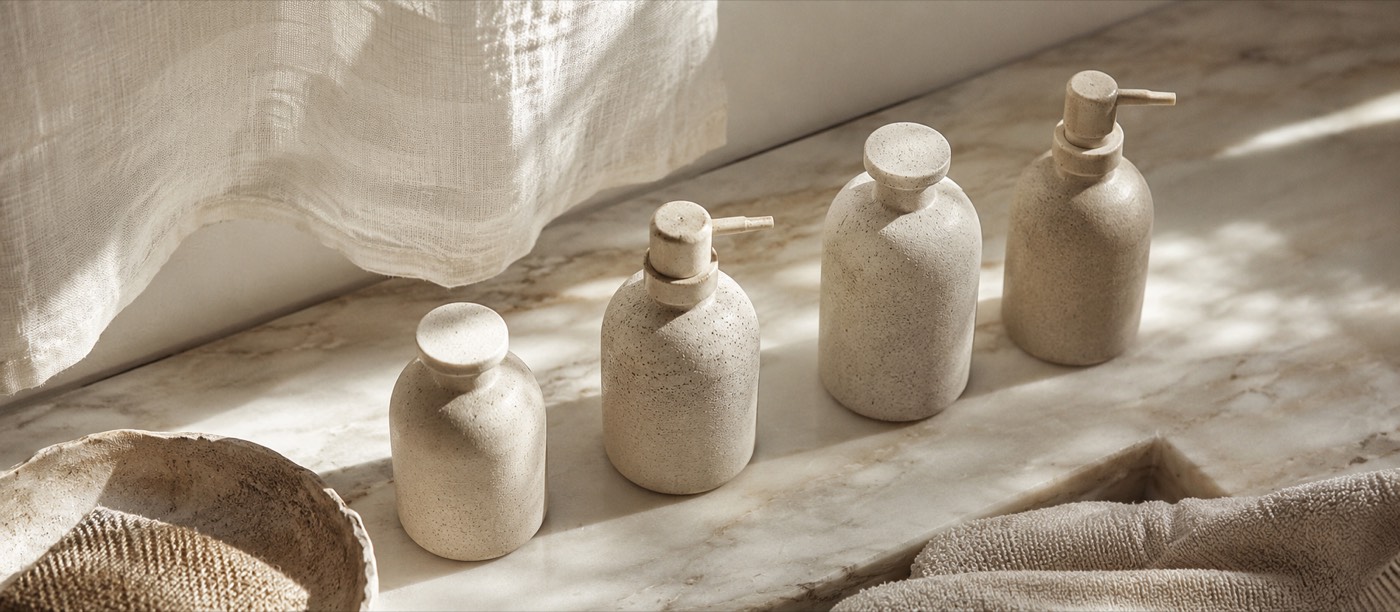
Many general managers, commercial directors, captains, and procurement teams across the Balearics and Mediterranean yachting are having the same quiet conversation right now.
The licensed luxury brands that once felt distinctive — Aesop, Le Labo, Acqua di Parma, Bvlgari and the others that followed — are now everywhere the high-end guest shops, travels, or stays. The exclusivity that justified the licence fee has largely evaporated for the exact demographic that books premium charters and distinctive island properties.
At the same time, the operational and regulatory reality has changed. PPWR deadlines are real. Balearic Law 8/2019 is enforced. Crew are tired of chasing refills. Guests increasingly notice when the bathroom feels like every other five-star bathroom they have seen this season.
The question is no longer "which licensed brand should we licence?" It is: what is the genuine alternative that actually performs here, protects compliance, gives us operational control, and feels like it belongs to this place and this guest? This guide is for the people who have to answer that question with real programmes, real budgets, and real guest feedback.
The comparison that matters at sea and on island properties
| Criterion | Licensed Brands (Aesop, Le Labo, Acqua di Parma, Bvlgari) | Generic or Catalogue Suppliers | SOSOO |
|---|---|---|---|
| Formulation origin | Retail brand labs — widely distributed | Adapted hotel bases or catalogue stock | Developed in Seoul for marine and Balearic conditions |
| Exclusivity | Low — guests already own it at retail and airports | Low — same line used across many properties | High — place-tied collections not available at retail |
| Mediterranean and marine performance | Not designed for salt, UV, hard water, wind, or motion | Variable — typically hotel-spec only | Purpose-built for salt, UV, hard water, and barrier recovery after repeated exposure |
| PPWR + Balearic Law 8/2019 | Varies across licensed programmes | Often partial | Built in from day one with full documentation |
| Operational tools | Usually none | Basic or none | Full SOSOO Operating System included — bottle tracking, refill logging, compliance records |
| Place identity | None — global retail brand | Limited | Mallorcan landscapes for land properties; Mediterranean winds for yachts |
| Guest and crew comments | Rare — guests often already own it | Occasional | Frequently mentioned — scent, feel, and "this is different from what we see everywhere" |
This is the filter that decides whether a programme will produce guest comments or disappear into the background.
Why the licensed brands stopped delivering differentiation
The brands themselves did not change. The distribution did.
What was once a considered, limited placement in a handful of distinctive properties became global retail, airport duty-free, e-commerce, and hotel groups running the same line across dozens of locations. The guest who can afford a 15,000 to 30,000 euro charter week or a 1,200 euro night in a Balearic villa has almost certainly already encountered the same bottle in a hotel in another country — or bought the travel size at an airport.
When the guest has already smelled it, used it, and owns it at home, the signal on arrival disappears. Crew hear it directly: "Oh, they use the same one we have at the office."
This is not a criticism of the brands. It is a description of what happened to the category once the licences scaled.
What to evaluate when any supplier presents a programme
1. Was this formulation created for the conditions it will actually face? Mediterranean and charter conditions are demanding in ways that standard hotel environments are not. Salt accumulates and dries on skin and hair. UV is constant and strong. Marina water is often very hard. Boats move. Guests rinse frequently. A product that feels good on day one of a land stay can feel tight, stripping, or greasy by day three of a charter. Ask any supplier to show stability and performance data after salt, UV, and hard water exposure cycles that match real use. Ask which surfactants they use and why. Ask how the ceramides and humectants behave after repeated environmental stress. If the answer is "our base is used by many hotels in the Mediterranean," the product was adapted from a standard hotel chassis — not engineered for these stressors. SOSOO formulations were developed in Seoul specifically for marine and Balearic conditions.
2. Can a guest buy this collection at an airport, in duty-free, or in another property they visited last month? Place-tied identity is one of the most underestimated factors in programme performance. When the guest who has seen everything else encounters something specific to this island or this sea, it produces a different reaction from encountering a brand they already own. La Serra (for land properties — hotels, villas, spas) and La Rosa dels Vents (for superyachts and charter fleets) were created so the collection feels like it belongs to Mallorca or the Mediterranean wind. Guests cannot find it anywhere else.
3. Can you hand the full compliance file to an inspector or charter manager tomorrow morning? PPWR (EU Regulation 2025/40) takes general effect in August 2026. Balearic Law 8/2019 is already being enforced. Ask any supplier: Do you have complete CPNP notifications, safety assessments, stability reports, and PETA statements for every SKU? Can your system produce the exact audit records a charter company or hotel group needs — who refilled what, when, on which vessel or room? Many suppliers can show a nice bottle and a price list. Fewer can show the full traceable file. SOSOO programmes include the full documentation package from day one. The Operating System makes ongoing records automatic rather than a manual burden.
4. Who actually tracks the bottles, logs the refills, and triggers reorders? This is the part that rarely appears in the pitch deck but quietly destroys crew morale and guest experience after the programme launches. Ask any supplier whether they include a system for tracking individual bottles, logging refills by room or cabin, seeing live stock cover, and triggering reorders based on occupancy — or whether you are still managing amenity stock in a shared spreadsheet and WhatsApp group. The SOSOO Operating System is included with every programme at no additional cost because this is where most amenity programmes fail once they are live.
5. Will guests actually comment on it? The strongest proof that a programme is working is when crew voluntarily mention it in the debrief, or guests write it in the guest book at checkout. Generic and ubiquitous licensed options rarely produce this — they are background. A programme genuinely formulated for the conditions, carrying a sense of place, and feeling different in the hand and on the skin produces comments. That is the expected outcome when a product is built for the environment rather than adapted to it.
The SOSOO approach in practice
Two collections, one operating system.
La Serra (land properties) is tied to Mallorcan landscapes and light. For hotels, villas, and spas where guests should feel they are somewhere specific — not in another property that happens to have the same global brand on the sink.
La Rosa dels Vents (superyachts and charter fleets) is wind-themed, with tiers — Voyage, Charter, Atelier — specified for marine packaging durability, realistic seasonal volumes, and conditions that standard hotel amenity programmes were never designed for.
Every programme includes the full SOSOO Operating System at no additional cost — bottle-level tracking, live stock visibility, refill logging, occupancy-based reordering logic, and the compliance records the captain or GM actually needs. Production and primary operations are in Spain, with Korean formulation and OEM partnership. Delivery into the Balearics and Mediterranean yachting is local.
We position this explicitly as the alternative for operators who have decided that the ubiquitous licensed route no longer delivers the exclusivity, performance, or operational simplicity their properties and fleets require.
If you are evaluating options right now
You do not need another glossy brochure. You need a short, honest conversation about the conditions your guests and crew actually face, the documentation and records you will be asked for in 2026 and beyond, and what place-specific would actually mean for your properties or vessels.
Start a brief. Tell us where you are, what you are running today, and what problem you are most trying to solve — exclusivity, compliance, crew time on refills, or all three. We will come back with a clear proposal and the exact documentation package you would receive.
Or contact us directly at cs@sosooamenities.com.
A practical tool for teams comparing multiple suppliers
We condensed the evaluation framework above into a one-page scorecard: 5 Questions Every Captain and GM Should Ask an Amenity Supplier in 2026. Designed to be taken into a meeting, forwarded to a commercial or procurement team, or used when three proposals are on the table at once.
To receive the printable version, use the brief form at /start and note "5 Questions checklist" — or email cs@sosooamenities.com with your name, company or vessel, and one sentence about your timeline. We will send it immediately.
FAQ
Why are hotels and yachts moving away from the big licensed brands? The brands scaled into global retail, airports, and multiple hotel groups. The exclusivity that once justified the licence premium is no longer there for the guest who books at the top end. The guest most likely to stay in a premium Balearic property or charter a high-end vessel already owns or has encountered the same line in several other places this season.
Is it still acceptable to use a well-known brand if the guest responds to it? Of course. Many properties still do, and some guests still respond to the name. The question is whether that name is delivering the differentiation and operational simplicity you are paying for — or whether it has become table stakes that no longer moves the needle with the exact guest you are trying to impress.
How deep should we go on formulation evaluation for amenities? Deeper than most suppliers expect. Salt, UV, hard water, motion, and frequent re-use change how surfactants, humectants, and barrier ingredients perform. A product never tested or formulated for marine or coastal conditions will show it after the second or third use on a charter.
What does the operating system mean in day-to-day operations? It means you stop managing amenity stock and refills in a shared spreadsheet. Every bottle is trackable. Crew log refills against specific rooms or cabins. Stock cover and predicted reorder dates are visible based on real occupancy. Compliance records are generated as a byproduct rather than a separate manual project.
Do you work with both hotels and superyachts? Yes. La Serra (land properties) and La Rosa dels Vents (yachts and charter fleets) share the same formulation philosophy and operating system but are specified differently for volume, packaging durability, and guest flow.
How long does it take to get a programme in place? From brief to first delivery is typically 14 to 20 weeks. Start the brief here.
Get in touch
cs@sosooamenities.com →