SOSOO Amenities · Resources
The Chief Stew Guide to Charter Yacht Amenities: What Works on Board
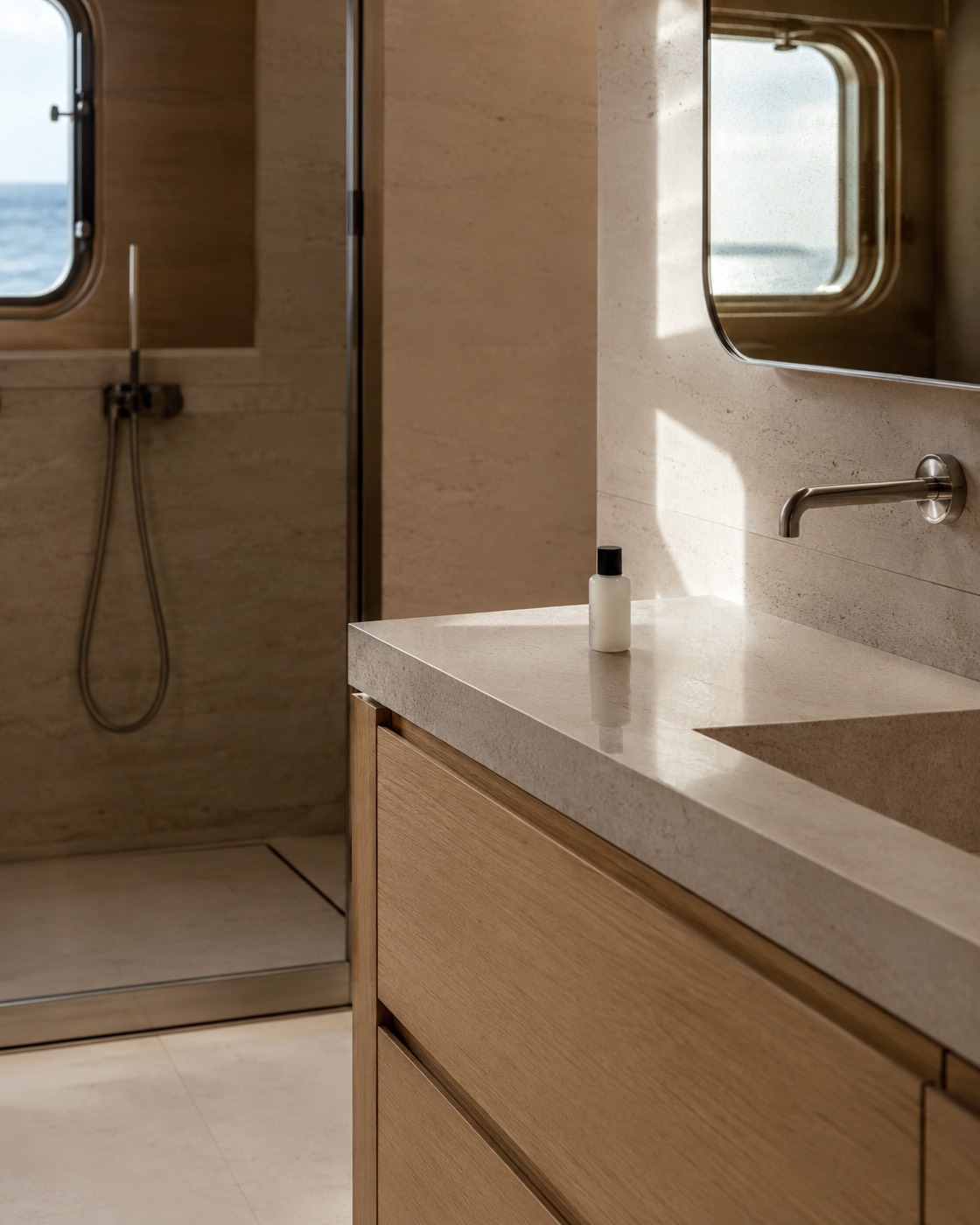
The captain signs off on the programme and the owner may never see it. The chief stew is the one who sets up the cabins at turnaround, keeps track of what is left, and hears what guests say about the bathroom at the end of the charter.
This guide is written for that job: what to look for in a yacht amenity programme, what to plan before the season, and the paperwork worth having on board. Every rule links to the official text.
Turnaround is the test
Everything about an amenity programme is tested at turnaround. Between one charter leaving and the next arriving, every cabin is cleaned, laundered and reset, often in a few hours. Amenities are one of many jobs happening at the same time.
A programme that works at turnaround has three things:
- A fast, clean refill or reset. Whatever the format, setting a cabin should be quick, need no tools and leave no mess.
- A simple count. You should know what is left without emptying lockers. A short list of formats, the same in every cabin, makes that easy.
- Enough on board for the whole charter. Running out mid charter is the failure guests remember. Plan quantities from the season's bookings and guest numbers, not from a guess.
Plan the season before it starts
Many amenity programmes, including ours, are made to order for each season rather than shipped from stock. That has one consequence for the interior team: the order has to be planned well before the first charter.
Before preseason, it helps to have:
- the number of cabins and berths, and the formats you want in each,
- the expected number of charter weeks and guests,
- crew products, if they are part of the order,
- where the products will be stored on board, and how warm that space gets.
Lead times are confirmed in writing with the brief. Planning in winter means the products are on board before the first guests in spring.
What guests notice
Guests at the top of the charter market have stayed in many hotels and been on many yachts. What they comment on is rarely the brand name:
- How hair and skin feel after the sea. A guest who has swum off the swim platform all day showers in the evening. Salt, sun and wind leave hair and skin dry. Our guide on saltwater and hair explains why.
- The scent. A fragrance tied to a place stays with the memory of the trip. One they have met in three hotels this summer does not.
- Something they have not seen before. A considered product, in a bottle that suits the boat, is noticed. A familiar licensed brand is not.
The paperwork worth having on board
At some point a charter manager, a management company or the owner will ask what the products on board are and whether they comply. The EU cosmetics rules in Regulation (EC) No 1223/2009 require, for every product:
- An EU Responsible Person, named with an address on the label.
- A product information file held by the Responsible Person, including a safety assessment.
- A CPNP notification made before the product is placed on the market.
On the label itself, look for the batch number, the ingredient list and either a date of minimum durability or, for products that last more than 30 months, the period after opening symbol: an open jar with a number of months.
For products used in dispensers or refillable bottles, ask the supplier for the result of the preservative efficacy test for each formula. ISO 11930 is the method commonly used. It shows the formula stays microbiologically safe through repeated use.
Keep the supplier's confirmation of these points in one folder, on board and digitally. You will not need it often, but when you do, you will need it that day.
Does the 2030 hotel toiletry rule apply to yachts?
From 1 January 2030, Regulation (EU) 2025/40 restricts single use packaging for toiletries "for the use in the accommodation sector, as described in NACE Rev. 2" (Annex V, point 5). The examples given are shampoo bottles, hand and body lotion bottles and sachets around bar soap.
In NACE Rev. 2, renting pleasure boats with crew is classed under 50.10, sea and coastal passenger water transport. Renting pleasure boats and yachts without crew is under 77.21. Neither is accommodation, which is division 55. On a strict reading, crewed charter yachts are therefore outside point 5.
That is not yet confirmed. The Commission must publish guidelines explaining Annex V, with examples and any exemptions, by 12 February 2027, and its PPWR FAQ does not address yachts. Refillable bottles and dispensers are not single use packaging, so they are the format that is safe under any reading.
In the Balearic Islands, Law 8/2019 also bans products containing microplastics. Ask for every formula to be checked against it.
Storage on board
Products on a yacht spend weeks in lockers that can get warm in summer. Heat affects texture and fragrance. Before you accept a product for the season:
- ask whether it has been stability tested, including at warm temperatures,
- store it in the coolest dry space available, away from engine room heat,
- use older batches first.
Questions to ask any amenity supplier
- Who is the EU Responsible Person for each product?
- Can you send the CPNP confirmation and the preservative efficacy test result for each formula?
- Has each formula been stability tested at warm temperatures?
- What are the lead times, in writing, for a full season's order?
- Can the products carry the yacht's own name?
- For the Balearics: has each formula been checked against the microplastics ban?
Frequently asked questions
Are miniatures banned on charter yachts from 2030? The restriction is written for the accommodation sector, and crewed yacht charter is classed as water transport. Commission guidelines due by 12 February 2027 will clarify the scope. Refillable formats are outside the restriction either way.
What should we keep on board for compliance? For each product: who the EU Responsible Person is, confirmation of CPNP notification, and for refillable formats the preservative efficacy test result. Keep it on board and digitally.
Can the yacht have its own branded amenities? Yes. Products can carry the yacht's name and a fragrance chosen for it, made to order for the season.
How early should we order for the season? As early as possible in winter. Lead times are confirmed in writing with the brief.
Sources
- Regulation (EC) No 1223/2009 on cosmetic products
- Regulation (EU) 2025/40 on packaging and packaging waste (Article 25 and Annex V)
- European Commission: PPWR frequently asked questions (August 2026)
- Eurostat: NACE Rev. 2 statistical classification of economic activities
- Balearic Law 8/2019 (BOE)
Planning next season's amenities? Discuss an amenity programme for your yacht.
Get in touch
cs@sosooamenities.com →