SOSOO Amenities · Resources
Beauty Mini Bars and Hotel Guest Retail: What the 2030 Packaging Rule Covers, and What Is Still Open
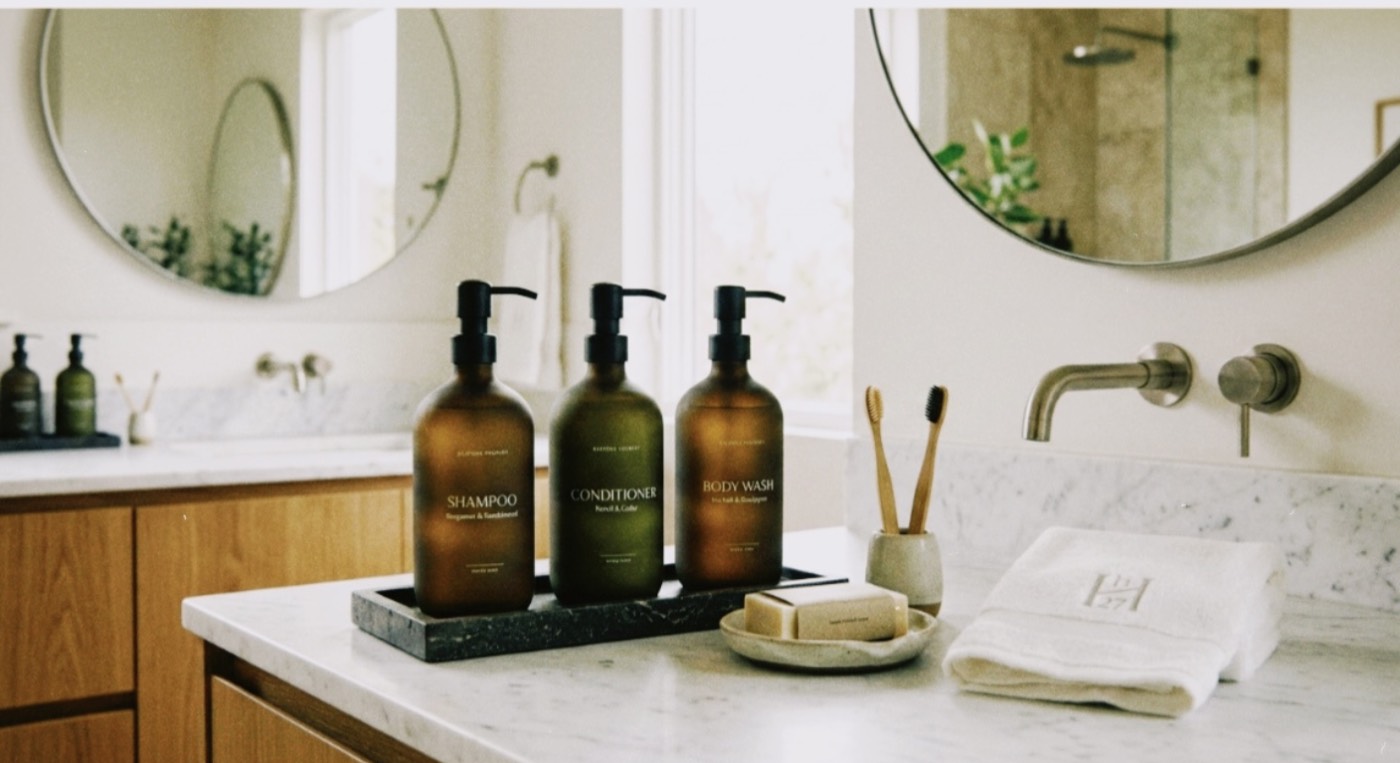
Some hotels now keep a beauty mini bar in the room: skincare and bath products the guest can open and buy, next to the drinks. Others sell their own bathroom line in retail sizes at reception or in the spa. Both raise the same question: how does this sit with the EU rule on single use toiletry packaging that applies from 2030?
The honest answer is that part of it is settled and part of it is not. This guide sets out which part is which, and the cosmetics rules that apply to anything a hotel sells. Every rule links to the official text.
Amenity programmes for hotels and resorts
What the 2030 rule says
The Packaging and Packaging Waste Regulation, Regulation (EU) 2025/40, restricts certain packaging formats listed in its Annex V. Under Article 25(1), economic operators may not place them on the market from 1 January 2030.
Point 5 of Annex V covers "single-use packaging for cosmetics, hygiene and toiletry products for the use in the accommodation sector, as described in NACE Rev. 2", that is "intended for an individual booking only and intended to be discarded before the next guest arrives". The examples given are shampoo bottles, hand and body lotion bottles, and sachets around bar soap.
Three things follow from the text itself:
- There is no size threshold. The final text does not mention 50 ml or 100 g. Those figures came from the 2022 proposal and are not in the law.
- It is not limited to plastic. The point covers single use packaging, whatever it is made of.
- It restricts packaging, not products. The Commission's FAQ makes this point directly: the products themselves can still be offered without that packaging.
The open question: products guests buy
A mini bar product is different from a free miniature in one obvious way: the guest pays for it and usually takes it home. Does that take it outside the rule?
Not automatically. The Commission's PPWR FAQ, answering a question on hotel miniatures available on demand, notes that the Regulation does not exempt miniatures available on demand or purchased at the hotel as such. What decides it is whether the packaging is intended for an individual booking.
Which formats that covers has not been decided. Article 25(6) requires the Commission to publish guidelines explaining Annex V, with examples of formats in scope and any exemptions, by 12 February 2027. The FAQ says the Commission intends to consult the hospitality sector first.
So, until February 2027, no one can tell you with certainty that a beauty mini bar is in scope or out of scope. Anyone who does is guessing.
How to plan before the guidelines
A mini bar or retail range planned now will still be on sale in 2030, so plan it to survive either answer:
- Size and format for take home use. A product sized and packaged for a guest to keep using at home is easier to defend than a single use miniature with a price tag. It is also what guests actually want to buy.
- Keep the bathroom and the retail shelf separate. In room amenities for the stay can move to refillable dispensers, which are not single use packaging. Retail stays retail.
- Avoid formats you would have to withdraw. If the guidelines go the strict way, a stock of priced miniatures is a write off. Made to order production per season keeps that exposure small.
- Review the range when the guidelines are published. Put a date in the diary for February 2027.
Selling cosmetics in a hotel
Whatever the packaging outcome, a hotel that sells cosmetics is making them available on the market, and the Cosmetics Regulation applies.
As a seller, the hotel is a distributor. Under Article 6 of Regulation (EC) No 1223/2009, before making a product available a distributor must check that key label information is present (including the Responsible Person's name and address, the batch number and the ingredient list), that language requirements are met, and that the date of minimum durability, where there is one, has not passed.
In Spain, parts of the label must be in Spanish. Article 6 of Royal Decree 85/2018 requires the nominal content, the date of minimum durability, the precautions for use and the product's function to appear in Spanish on cosmetics made available to end users in Spain. A beautiful imported product with an English only label is not ready for a Spanish mini bar.
Imported products show where they come from. Article 19 requires the country of origin on imported cosmetic products.
A product under the hotel's own name changes who is responsible. Article 4(6) makes a distributor the Responsible Person when it places a product on the market under its own name or trademark. For a hotel line, settle this in the contract before launch: who is the Responsible Person, whose name and address goes on the label, and who holds the product information file.
In the Balearic Islands, two more rules apply. Law 8/2019 bans products containing microplastics, so every formula sold in a Balearic hotel should be checked against it. And since 2022, the tourism law (Article 102.1.c) has not allowed tourist accommodation to put single-use bath amenities out for guests, except on an individual request with reusable, recyclable, biodegradable or compostable packaging. Free miniatures in the room are already out in the Balearics. How the rule treats products the guest buys has not been tested, so plan retail formats the same way.
A curated mini bar or the hotel's own line
There are two ways to run guest retail.
A curated selection of other brands. Quick to start, and guests may recognise the names. The hotel acts as a distributor, earns a retailer's margin, and the products could be found anywhere.
The hotel's own line. The same formulas guests use in the bathroom, in retail sizes under the hotel's name. The guest takes the hotel home with them, and every product they buy is one they can only buy from you. It needs more planning: the Responsible Person question above, label design, and a production run sized to the season.
Many hotels do both: the bathroom line in retail sizes, with a few complementary products alongside.
A checklist before you open a beauty mini bar
- Every product has an EU Responsible Person, a safety assessment and a CPNP notification.
- The label shows the Responsible Person, batch number and ingredient list.
- Nominal content, durability date, precautions and function are in Spanish.
- Imported products show their country of origin.
- For your own line, the Responsible Person is agreed in writing.
- Formats are sized for guests to take home, not single use miniatures.
- Balearic hotels: every formula checked against the microplastics ban.
- A review date set for the Commission guidelines, due by 12 February 2027.
Frequently asked questions
Are beauty mini bars banned from 2030? Not as such. The rule restricts single use packaging intended for an individual booking, not products. Whether priced products in the room fall within that is for the Commission guidelines due by 12 February 2027 to clarify.
Is there a size under which miniatures are banned? No. The final text has no 50 ml or 100 g threshold.
Can we sell imported K-beauty products with Korean or English labels? Only if the label information Spain requires in Spanish is there, and the product has an EU Responsible Person and a CPNP notification. Check before it goes on the shelf.
Do we become the Responsible Person if we sell our own line? A distributor that places a product on the market under its own name or trademark becomes the Responsible Person under Article 4(6). Agree the arrangement in writing before launch.
Sources
- Regulation (EU) 2025/40 on packaging and packaging waste (Article 25 and Annex V)
- European Commission: PPWR frequently asked questions (August 2026)
- Regulation (EC) No 1223/2009 on cosmetic products (Articles 4, 6 and 19)
- Royal Decree 85/2018 on cosmetic products, Article 6 (BOE)
- Balearic Law 8/2019 (BOE)
- Balearic tourism law, Law 8/2012, Article 102 (BOE)
Planning a hotel line or guest retail range? Discuss an amenity programme for your hotel.
Get in touch
cs@sosooamenities.com →