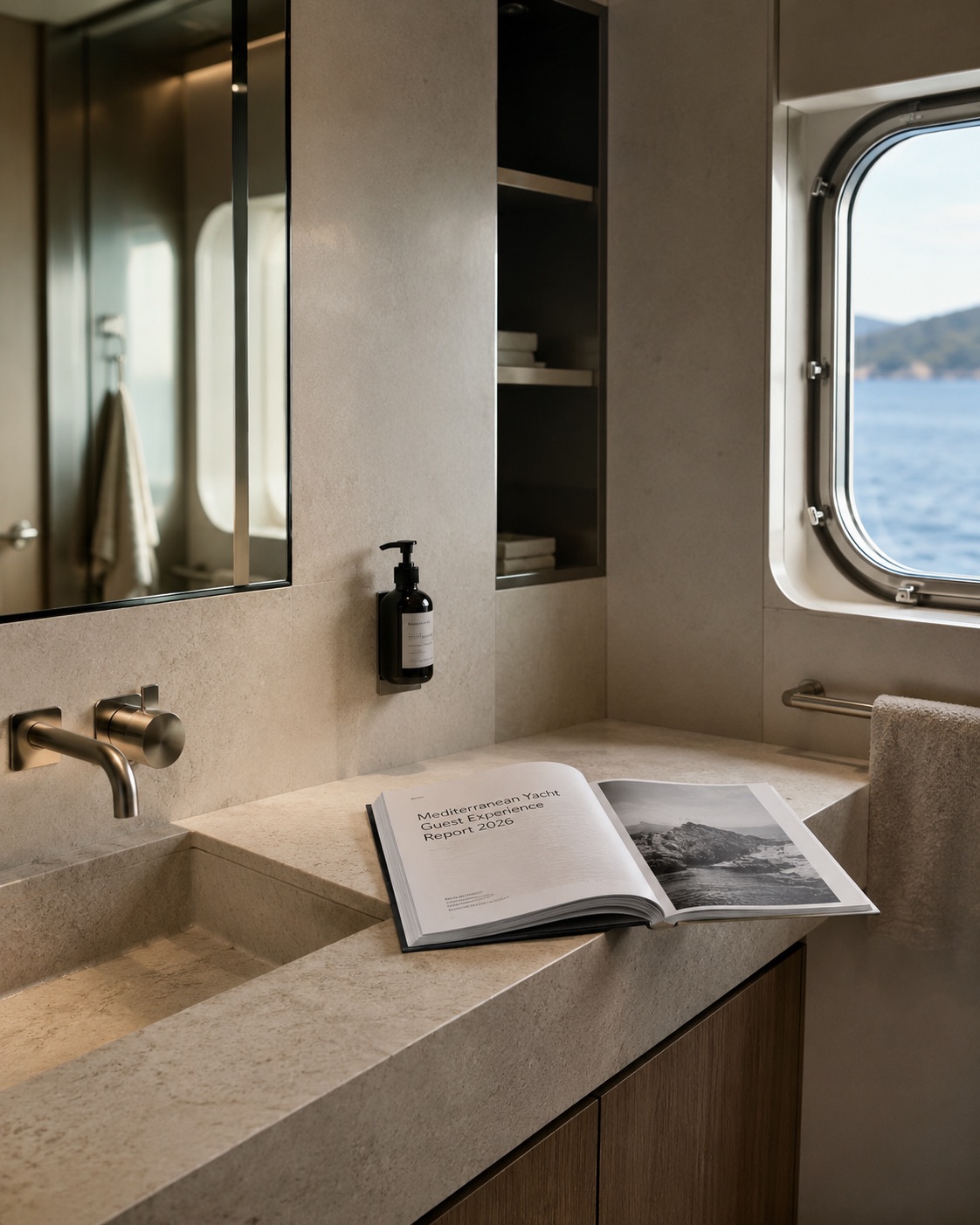
Annual Report — 2026 Edition
Annual Report — 2026 Edition
An annual reference on the state of amenities aboard Mediterranean yachts, written for owners, management companies and interior crew. This 2026 edition draws on SOSOO’s field experience supplying Balearic and Mediterranean vessels, and on the published EU and Balearic regulation shaping the market. It is analysis, not advertising: where the industry stands, what guests actually notice, and what the next few seasons demand.
The single most important fact about yacht amenities in 2026 is that regulation is now a runway, not a rumour. Three instruments overlap for vessels operating in the western Mediterranean, and each is at a different stage of enforcement.
Balearic Law 8/2019 is in force now, restricting named single-use items and products containing microplastics in the islands. The EU Packaging and Packaging Waste Regulation (PPWR) has applied since 12 August 2026. The single-use toiletry miniature ban (PPWR Annex V, under 50 ml / 100 g) applies from 1 January 2030.
The industry error we see most often is treating this as one 2026 deadline. It is a layered timeline, and sophisticated buyers catch a supplier who overstates it.
The practical reading: a programme specified today should be compliant across the whole runway, not just the nearest date. The detail for vessels is in the Mediterranean superyacht compliance guide.
The guest at the top of this market has met the licensed luxury brands. They are distributed through global retail, airport duty-free and dozens of hotel groups, so a charter guest has usually encountered the same bottle this season or owns it at home. In our experience, familiarity has quietly eroded the signal those brands once carried on board.
What guests do notice, consistently, is performance in marine conditions. The most common quiet complaint interior crew relay to us is hair: dry, rough and dull by mid-charter. That is not bad luck, it is chemistry — salt, ultraviolet and hard marina water acting together. We have written the mechanism up in detail: saltwater, UV and hard water.
The differentiator has moved from the label on the bottle to the performance of what is inside it in salt, sun and hard water.
The owner rarely handles the amenities; the chief stewardess does, several times a day, during turnarounds that can be a matter of hours in peak-season heat. A programme designed for a boat show pitch and a programme designed for that turnaround are very different things.
The recurring operational pain points we observe are stock visibility across a season, reorder timing that does not depend on someone’s memory, and documentation that can be produced on request. These are solvable with a managed programme rather than a purchase. The interior perspective is set out in the chief stewardess guide and how a programme actually runs.
Refillable systems have moved from a sustainability gesture to the default compliant format. The concern crew raise first is hygiene, and the answer is a closed, tamper-evident system with documented refill logs, not a bottle topped up by hand. Specified well, a ceramic or glass vessel reads as more considered than a rack of plastic miniatures, not less.
The move is as much operational as environmental: it removes a season’s worth of plastic to store, land and dispose of. The full picture is in refillable yacht amenities and the plastic-waste analysis.
Three things follow for owners and operators looking past the 2026 obligation date.
Specify for the full runway. A refillable, documented programme now avoids re-tooling before the 2030 miniature ban. Buy formulation, not a label. Marine performance is where guest recall is won, and it cannot be copied by matching a bottle. Run it as a system. The programmes that survive a season intact are the ones with stock and compliance tracked centrally rather than by hand. The definitive overview is the pillar: yacht amenities, the complete guide.
This 2026 edition is an analysis grounded in two sources: SOSOO’s operational experience developing and supplying amenity programmes for Balearic and Mediterranean vessels, and the published texts of Balearic Law 8/2019 and EU Regulation 2025/40 (PPWR). Where we describe what guests and crew report, we mean qualitative feedback relayed to us in the field; we have deliberately not attached invented figures to it.
Contribute to the data edition
We are gathering anonymous input from chief stewardesses, pursers and management companies for a data-backed edition of this report. If you run or provision an interior, we would value your perspective. Take the 3-minute survey. All responses are anonymised and no vessel or company is named.
Reviewing your amenity programme for the season ahead?
Start a brief →