Start
Start your brief.
We build the amenity brands hospitality buys. Formulated and manufactured in Korea, compliant in Europe. Start with six details, and we send the Product Development Form after your enquiry.
Send an enquiryWho it's for
Founders first.
Independent founders
You have launch capital and want an amenity brand built properly: formula, packaging and a compliance file that stands up, without building a lab or a regulatory team.
Hotels, yachts, golf and spas
The markets the brands are built for. Purchasing teams at hotel groups, yachts and golf clubs can also commission a brand of their own.
Agencies and provisioners
Introduce a client with a brand in mind and we work with you on the brief.
Launch roadmap
Six stages, with a go/no-go at each.
Typically 14 to 20 weeks from signed brief. Each stage ends with a checkpoint, and the next stage starts only when you approve it.
- 01BriefWeReview your Product Development Form and agree the scope: SKUs, markets and channel.YouConfirm the products, target markets and budget bracket.CheckpointSigned brief
- 02FormulationWeSelect manufacturers against your brief, coordinate base formulas and fragrance options, and manage adjustments.YouChoose the formula direction and fragrance.CheckpointFormula approval
- 03PackagingWeSource formats and materials, and assess packaging against the applicable PPWR requirements.YouApprove format, material, fill size and decoration.CheckpointPackaging approval
- 04ComplianceWeBuild the Product Information File, coordinate the safety assessment with a qualified assessor, and manage the CPNP notifications.YouApprove label copy and product claims.CheckpointCompliance file complete
- 05ProductionWeConfirm cost and MOQ in writing, then coordinate production and quality checks.YouApprove the production order.CheckpointSigned production order
- 06Route to marketWePlan shipping into the EU and the route into your chosen channels.YouDecide pricing and where the brand is sold.CheckpointLaunch
How we protect your capital
You see the exposure before you commit.
Staged commitments
You commit one stage at a time. Nothing goes to production until formula, packaging and compliance are approved.
Cost and MOQ before commitment
Cost and minimum order exposure are set out in a written proposal before you sign a production order.
Formula ownership option
Formula ownership is available as an option, so what you pay to develop can stay yours.
Clear compliance roles
An outsourced EU Responsible Person is appointed for each product. The safety assessment (CPSR Part B) is signed by a qualified safety assessor. We hold the Product Information File, manage the CPNP notifications and give you an audit-ready compliance record.
SOSOO does not use client formulas, data or contacts for any other brand.
Sample programme
Compare before you choose.
Evaluation samples from more than one manufacturer, so you can compare. Each set includes base formula samples, fragrance options and sample packaging, shipped with tracking. A sample fee applies, and the details are sent after your enquiry.
- 01Send the six details in the form below.
- 02We email you the Product Development Form and the sample programme details.
- 03Return the completed form and pay the sample fee.
- 04We select manufacturers based on your form, approach and budget.
- 05Samples are shipped to you with tracking.
- 06We go through them with you on a feedback call.
- Evaluation samples come from standard ranges only and do not represent a final customised formula unless stated.
- Custom formula development is not included.
- Work starts when both the completed Product Development Form and the payment have been received.
- Samples are for evaluation only, with no guarantee of a specific formula, price or timeline.
- Information you share is treated as confidential.
Founder guides
Checklists and playbooks, free by email.
EU compliance checklists for hotels and yachts, free to download. Enter your email and we'll send the PDF.
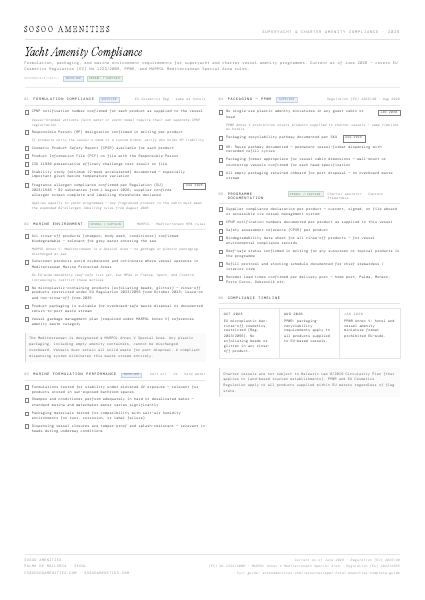 Free · €0
EU Compliance Checklist: Yacht
Run your current onboard amenity setup against Balearic Law 8/2019 and the EU PPWR timeline. Most operators find gaps.
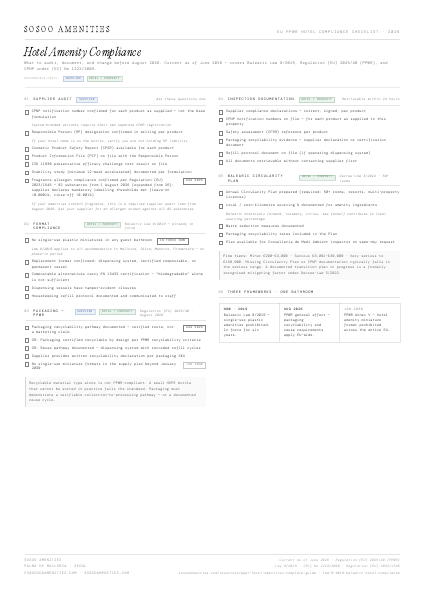 Free · €0
EU Compliance Checklist: Hotels
& Properties
The PPWR readiness checklist for hotels and boutiques: refillable obligations, the 2030 miniature restriction, and where to start.
Enquiry
Six details to begin.
A brief is not a commitment. Information you share is treated as confidential.